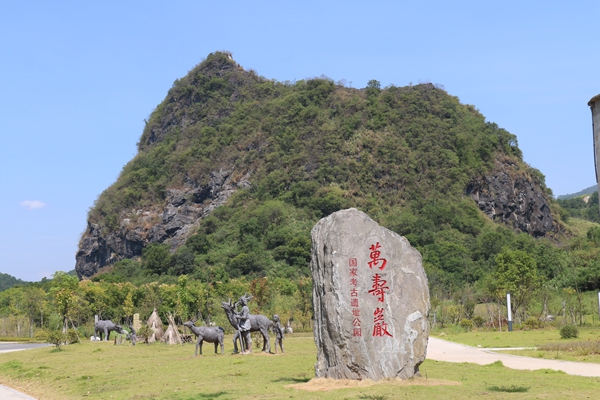
Wanshouyan Hills Site
Introduction
Wanshouyan Hills, located in Sanming city, Fujian province, is an archaeological site that has provided significant insights into the lives of early humans in coastal China. Known as "the rock of longevity", the Wanshouyan site contains a complex of caves that have revealed Paleolithic findings, including tools and animal bones, suggesting human activity dating back approximately 185,000 years. This site stands out as one of the oldest known evidence of human presence in coastal China, offering a crucial page in the global context of human evolution studies.
Historical Significance
The Wanshouyan Hills site has played a vital role in filling the gaps in the archaeological chronology of Fujian province regarding the Paleolithic period, which spans from approximately 2 million to 10,000 years ago. Before the discoveries at Wanshouyan, little was known about prehistoric human settlements in the region. Initial interest in the area began in the 1980s when modern human teeth, dating back roughly 11,000 years, were found in Sanming. Subsequent expeditions in the 1990s, led by researchers including Yu Shengfu, director of the Sanming Conservation Center for Cultural Heritage, uncovered numerous fossils and lithic artifacts that pointed to human activities during the Paleolithic era.
Archaeological Discoveries
The site has yielded over 70 stone tools, bone artifacts, and an artificial ground surface constructed on limestone blocks, believed to date back 40,000 years. This limestone-block floor, considered an early example of human "interior design", is unique in China and rare globally. The tools found at Wanshouyan, including scrapers and chopping tools, display both similarities and distinct features compared to other stone-tool traditions in southern China.
In the late 1990s, the site faced threats from industrial expansion. The discovery of lithic artifacts in Lingfeng Cave in 1999 prompted a "rescue" excavation, which led to the identification of retouched tools and further confirmed the site's significance. The continued research at Wanshouyan has uncovered over 800 lithic artifacts and bone tools, dating from 10,000 to 30,000 years ago, further enriching our understanding of early human life in the region.
Preservation and Protection Efforts
The preservation of Wanshouyan Hills has been a complex and challenging process, involving local communities, government officials, and archaeologists. In 2000, the site received critical support from provincial authorities, leading to the suspension of quarrying activities and the establishment of a comprehensive protection plan. In 2002, a special administration for Wanshouyan was set up, and regulations were promulgated to oversee the site's preservation.
The site's inclusion in China's top 10 archaeological discoveries in 2000 and its rating as a national-level heritage site under key protection underscore its cultural and historical value. Efforts to protect and promote Wanshouyan have included the introduction of tourism, with the opening of an archaeological park in 2019, and plans for a new archaeological-ruins park to offer more exhibitions and interactive activities.
Cultural and Academic Impact
Wanshouyan has become a focal point for academic study and travel, attracting scholars and tourists alike. The findings at the site have implications for understanding early human migrations and cultural exchanges in the region, including potential connections between early human settlements in Fujian and Taiwan provinces. Scholars believe that the site provides a critical link in studying the origins, migrations, and mutual influences among humans in eastern Asia.
The site's management emphasizes the importance of involving the broader society in its preservation and development. Initiatives to improve the local environment and promote eco-friendly tourism aim to balance cultural-heritage protection with economic benefits for the community.








